How to Make Money in Tarkov: 7 Reliable Income Streams
From zero-gear scav runs to passive bitcoin, ranked by startup cost.
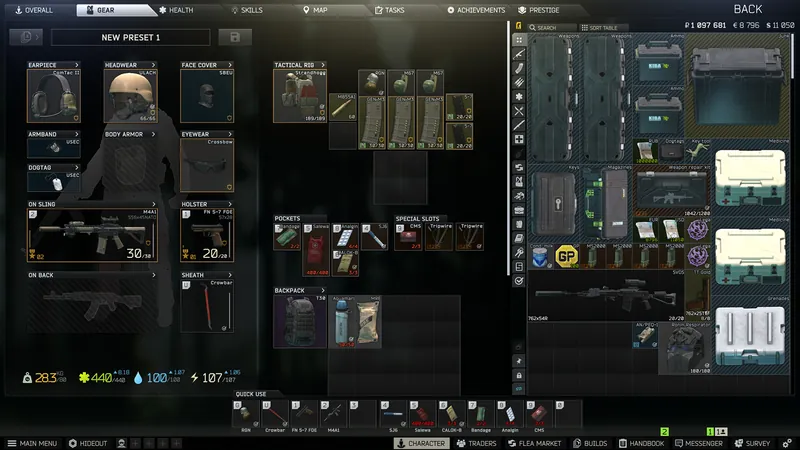
The decision first
Start with extraction consistency.
- Start with extraction consistency.
- Use Scav runs for low equipment exposure.
- Compare crafting inputs with the output you can actually sell.
- Treat Bitcoin Farm as capital-intensive production.
- Quest rewards combine income and progression.
- Key-room routes need a realistic survival plan.
The problem this guide solves
Every fresh account and every new season begins the same way: your stash is thin, most traders are still locked, and each raid kit feels like a serious investment. This guide exists to fix that exact situation. It lays out how to build a steady flow of roubles, dollars, and euros in Escape from Tarkov without leaning on lucky raids or recycled hype. It is written for players who already understand extraction basics and want an income system, not a lottery ticket.
Everything below was checked against Patch 1.1.5.0, the live build during Season 1 KORD BREACH, in September 2026. Tarkov's economy is one of the first things Battlestate retunes between patches. Patch 1.1.0.0 alone pushed trader sell prices up by roughly 25 percent on average, cut trader buyback by about 20 percent, and raised the flea market tax from 3 to 5 percent. Treat every number in this article as a dated snapshot, not a permanent law, and expect balance values to drift whenever a new patch lands.
One hard limit up front: this site does not publish live market prices, and this guide contains no ruble figures for loot or keys. The research behind it could not verify current market numbers, and flea prices swing violently with patches, seasons, and demand spikes. Value is described in qualitative tiers instead, and you should confirm any specific price on tarkov.dev before you build a farming plan around it.
The seven income streams below are ordered roughly by startup cost, from the completely free scav run up to the GPU-hungry Bitcoin Farm. You do not need all seven running at once. Most healthy accounts operate two or three streams in parallel: one active raid-based stream, one passive hideout stream, and quest rewards ticking away in the background while you play.
At a glance: seven income streams ranked by startup cost
Use this table to pick your starting point, then read the matching section for the details.
The startup labels describe the initial equipment or module commitment, not guaranteed net profit. Include consumed supplies, fuel, construction inputs, and failed raids when comparing an income method with your own results.
| Stream | Startup cost | Risk level | When it pays off |
|---|---|---|---|
| Scav runs | Free | Very low | From your first session onward |
| Quest rewards | Free | Low | Constantly, once Tour is underway |
| Targeted loot runs | One PMC kit per raid | Medium | Any level; scales with map knowledge |
| Hideout crafting | Module construction | Low | Once Workbench and Medstation are built |
| Key-room farming | Key purchase plus kit | High | Mid-wipe, when keys are affordable |
| Flea market selling | PMC level 15 | Medium | After unlock; roughly 5 percent tax on sales |
| Bitcoin Farm | Generator L3, Intelligence Center, GPUs | None after build | Late game; long payback period |
Ground rules before you chase rubles
Extraction is the multiplier on everything. A raid where you die with a full backpack pays only what sat in your secure container, and loot from a raid that ends in death loses its found-in-raid status, which matters both for quest hand-ins and for how you can sell it. The boring habit of leaving while you are ahead is the single biggest income skill in the game.
Protect your found-in-raid status on purpose. An item counts as found in raid when you picked it up in a raid that you exited with a Survived status, when you crafted it in your hideout, or when it arrived as a quest reward. Raids that end as Killed in Action, Missing in Action, Left the Action, or Run Through do not grant the mark. To avoid a Run Through, earn at least 200 experience from kills or looting, or stay in the raid for at least seven minutes before extracting.
Run secure container discipline. The most valuable item per slot you touch goes into the container immediately, and cheaper loot rotates out when something better appears. This turns even a failed raid into a partial paycheck and keeps your worst losses small while your bankroll is fragile.
Finish every raid with a selling routine. Sort the haul into three piles: sell now to the right trader or the flea, stash for a known hideout upgrade, and stash for an upcoming quest hand-in. Items you sell today that a quest demands as found-in-raid tomorrow are the most expensive mistake a new player makes, so keep a small reserve of common quest items like Salewas, gas analyzers, food, and building materials.
Stream 1: Targeted loot runs
A loot run is a raid with a route, not a raid with a hope. Instead of wandering the map and taking whatever fights find you, you plan a short path through known high-value spawn areas, fill your bag with dense value, and leave. Timesaver's per-map money guides, such as their Shoreline route breakdown, are built on exactly this principle: the money is in repetition of a known route, not in hero moments.
Map knowledge converts directly into income. Every map concentrates its best loose loot in a handful of buildings: the health resort wings on Shoreline, the tech and medical stores on Interchange, the marked rooms on Customs and Reserve, the military areas on Reserve and Lighthouse. Pick one map you enjoy, learn one five-to-ten-minute route through its richest area, and run that route until the spawns feel automatic.
Value per slot beats raw value. A graphics card is worth more than a toolbox, but the real comparison is what each item earns per inventory cell. Compact electronics, intel items, and jewelry outperform bulky junk even when their total price looks similar, because your backpack space is the actual bottleneck on every run.
Discipline closes the loop. Once your container and bag hold a good haul, extract. Greed is the main cause of death on loot runs, because the extra building you check is where another player's route crosses yours. A mediocre route extracted ten times outearns a perfect route that ends in a firefight half the time. Test your route over a small batch of raids, including every death. Record extracted loot sold, supplies consumed, replacement equipment purchased, and total time spent queuing, raiding, and selling. Subtract those expenses from the proceeds, then divide by the session's hours. Keep unsold quest reserves separate so their estimated value does not masquerade as spendable cash. If results disappoint, change one variable next session: skip a contested building, shorten the path, or reduce kit cost. Comparing similar sessions reveals whether a route fits your survival rate; copying somebody else's best backpack only shows what was possible once.
The evergreen high-value loot list
These item families have stayed valuable across many patches because quests, hideout modules, and barters keep demanding them. Prices themselves are unverified and volatile, so the tiers below are qualitative.
Memorize this list until grabbing the right items is reflex. When two items compete for the same slot, the tier table decides. Nothing here has a verified current price; check tarkov.dev when you need exact numbers.
Early in a season, the background tier quietly becomes the best money. Demand for screws, bolts, tape, matches, cigarettes, and electronic parts spikes while thousands of players push the same quests and hideout upgrades, and per our research these lowly materials can temporarily outsell glamorous loot. Sell into that demand instead of hoarding.
| Tier | Examples | Why demand persists |
|---|---|---|
| Jackpot | Graphics card, LEDX, Labs colored keycards | Rare spawns feeding hideout and quest demand |
| Premium | Physical bitcoin, Tetriz, intelligence folder | Compact, top value per slot |
| Solid | Military-grade items, gold chains, Rolers, optics | Steady trader, barter, and module demand |
| Background | Screws, bolts, tape, cigarettes, building materials | Quest and hideout spikes, strongest early season |
Stream 2: Scav runs, the zero-cost engine
The scav run is Tarkov's free lottery ticket with no downside. You enter a raid in progress as an AI-aligned scavenger with a random loadout you did not pay for, and everything you extract is pure profit. There is a cooldown between runs, so the optimal habit is simple: sandwich a scav run between your PMC raids and let the cooldown tick while you play your main character.
Your scav reputation, tracked as Fence karma, is real money over time. Karma improves the gear your scav spawns with, shortens scav cooldowns, reduces vehicle extract costs, and improves what Fence pays you. At karma 6.00 Fence unlocks his fourth loyalty tier with an additional tab carrying a 30 percent discount. Protect karma by not shooting AI scavs; kills on raiders, rogues, cultists, and bosses do not cost you karma.
Play scav raids like a vulture, not a shark. Late-raid maps are littered with the leftovers of PMC fights, and high-value spawn areas are often half-looted. Spawn in, listen, move toward where the shooting already happened, pick the battlefield clean, top up at one or two reliable loot spots, and walk out. Speed maps with short raid windows suit this style well.
Once your hideout has an Intelligence Center, Fence starts handing your scav character daily tasks worth roughly 0.01 to 0.05 karma each. Stack those with peaceful extractions, co-op extracts, and vehicle extracts, and your scav economy compounds: better spawn gear and cheaper exits make every future run worth more.
Stream 3: Hideout crafting
The hideout turns cheap inputs into sellable outputs while you do something else. The Workbench produces ammunition and weapon parts, the Medstation produces medical items using clean water from the Water Collector, and the Nutrition Unit produces food and drink. Each station converts looted or purchased materials into goods that sell for more than the sum of their parts, as long as you account for generator fuel.
Crafted items carry found-in-raid status, which makes crafting double as a quest tool. When a quest demands an FIR hand-in that refuses to drop, building it yourself is a legitimate path. The same mark matters for the flea market under the classic listing rules, so your crafting bench feeds both progression and income.
The famous passive loop runs through the Booze Generator and the Scav Case. Moonshine from the generator funds scav case runs, the case returns loot, and the loop converts idle time into a trickle of gear and sellable items. The Scav Case requires Intelligence Center level 1, which is why the community upgrade order pushes Security into Intelligence Center before luxury modules.
One honest limit: our research could not verify current per-recipe material lists, craft times, or per-module level requirements, and those details shift between patches. Do not trust any printed recipe table, including old wiki screenshots. Pull live recipe data from the official Wiki or tarkov.dev, compute material cost against sale price, and only then commit your bench queue. Looted ingredients still have an opportunity cost: you could sell them instead. Compare the finished goods' proceeds after fees with what selling the ingredients would actually return, then deduct purchased inputs and any additional fuel expense. Avoid charging the same generator fuel in full to every station when several operate together. A useful craft must also fit your schedule. A short recipe repeatedly left finished while you are offline may earn less per day than a longer recipe you can collect consistently. Check the calculation again before restarting; yesterday's profitable output can become today's crowded market.
Stream 4: The Bitcoin Farm
The Bitcoin Farm is the only truly passive income in Tarkov. Installed graphics cards produce physical bitcoins over time, and you sell those for roubles. Once it runs, it pays you for raids you never take, which is why every economy discussion eventually lands here.
The entry price is deliberately steep. Community consensus and the module documentation agree the farm demands a level 3 Generator, an Intelligence Center, and a stack of graphics cards, plus the fuel to keep the generator burning. That makes it a late investment with a long payback horizon, not an early-wipe goal. Solar Power trims fuel consumption later and shortens the true payback.
A necessary warning: exact bitcoin production rates per graphics card are not verified in our research and have changed across patches. Before sinking your savings into GPUs, check current farm math on the official Wiki or tarkov.dev and decide whether the payback window fits how long you expect this season's character to matter. Seasonal characters reset every four to six months under the Season 1 rules, which directly caps how much a farm can return. Separate the decision to build from the decision to expand. For the initial build, compare all remaining construction and operating expenses with the income you expect during your actual play window. For another graphics card, compare its cost with only the additional production it creates; total farm revenue would make that purchase look artificially attractive. Use a conservative sale estimate and leave enough cash outside the project to fund your next sessions. A farm that eventually breaks even can still be a poor purchase today if it consumes the reserve that keeps you raiding.
Stream 5: Quests and operational tasks
Quests are the most reliable income stream in the game because they pay in every currency at once: roubles, dollars, euros, items, trader reputation, and experience that unlocks everything else. Quest reward items arrive with found-in-raid status, so the reward stream also stocks your hand-in shelf.
Daily tasks unlock at character level 5 and weeklies at level 15. Rewards scale with your level, and published Wiki figures show mid-level dailies paying into the hundreds of thousands of roubles at the top of their range. You can pay roubles and reputation to reroll a bad daily, and Edge of Darkness owners get free rerolls. Make dailies a reflex; they are the steadiest paycheck in Tarkov.
Early quests double as an economy unlock path. Pushing the Tour story chapter and the low-barrier starter tasks opens Prapor, Skier, Peacekeeper, Mechanic, and Jaeger, and level 15 opens the flea market itself. Our early-quest-order guide sequences this so every raid advances several tasks at once.
Patch 1.1.0.0 quietly made questing more profitable than it used to be. The old trader sales-volume requirement is gone, so loyalty levels now cost only character level and reputation, both of which quests provide for free. You no longer burn a fortune buying and reselling to level a trader; you simply play their task list.
Stream 6: The flea market, selling and flipping
The flea market unlocks at PMC level 15, a long-standing design that survived the 1.0 release. Community reporting also indicates full access across all item categories does not arrive until level 40, with weapon, armor, and ammo categories gated at levels in between. Those intermediate category gates are unverified, so check what your own account can list as you level rather than trusting any printed schedule.
Mind the tax. The listing fee sits around 5 percent in 2026 after Patch 1.1.0.0 raised it from 3 percent, and this figure is version-stamped because fees are exactly the kind of lever Battlestate adjusts during economy rebalances. On thin-margin items, the fee decides whether a sale beats selling to a trader at all.
Now the flag you must not skip. The classic rule says only found-in-raid items can be listed, which is why flea-bought goods traditionally cannot be flipped straight back onto the market. The exact state of that listing rule after the 1.0 and 1.1.0 changes is unverified in our research. Before you plan any flipping strategy, list one cheap test item and read the current rule from the game itself.
Strategies that survive any version of the rules: sell your own FIR finds into demand spikes, because quest-item prices jump early in a season while everyone needs the same screws and salewas; stockpile common hand-in items before the rush and sell at the peak; and treat season launches and major patches as harvest season, when material demand and scarcity premiums are highest. Buy-low-sell-high arbitrage on flea-bought goods only works if the current listing rules allow relisting, which, again, is unverified.
Stream 7: Key-room farming
Keys convert one purchase into a repeatable income route: buy the key once, then run its room until the loot pays it back many times over.
The economics are a simple division problem: key price divided by expected room value per run equals your break-even raid count. Because neither side of that equation is verifiable at publication, do the division yourself with tarkov.dev prices on the day you buy, and remember that marked rooms attract other players, so your survival rate belongs in the math too.
Fresh detail for Season 1: Patch 1.1.5.0 moved Lighthouse's marked room out of the Lightkeeper peninsula, and the water treatment plant lost its fixed weapons and mines in the same rework, which changes the risk profile of farming that map. Balance moves like this are why key guides age fast.
| Map | Rooms and keys worth knowing | Notes |
|---|---|---|
| Customs | Dorm room 314 marked key, Tarcone Director's office | Marked room in the dorms building |
| Reserve | RB-BK, RB-PKPM, RB-VO marked keys | Three marked rooms on one map |
| Shoreline | Resort keys: East 310, West 301, East 226, West 216/220, East 328 | Health resort wing density |
| Interchange | KIBA inner and outer, 11SR keycard, Ultra medical storage | Tech and medical loot concentration |
| Streets of Tarkov | Abandoned factory and Mysterious room marked keys | Two marked rooms |
| Lighthouse | Shared bedroom marked key | Moved off the Lightkeeper peninsula in 1.1.5.0 |
| The Lab | Colored keycards; red card historically most valuable | Needs the access keycard; insurance is not returned there |
Selling smart: currencies, traders, and Fence
Tarkov runs on three currencies at once. Roubles handle most trader business, hideout upgrades, insurance, and repairs. Dollars flow through Peacekeeper for Western gear, and euros cover Mechanic's high-end parts. Because each trader pays in their own currency, you can convert loot into dollars or euros simply by selling to the right merchant instead of the highest rouble bidder.
Patch 1.1.0.0 widened the gap between the flea and the traders. Trader buy prices dropped about 20 percent on average while their sell prices rose about 25 percent. The practical consequence: bulk trash still goes to traders for convenience, but any premium found-in-raid item deserves a flea listing first, because the spread between the two channels is now much larger.
Fence is the buyer of last resort, not your accountant. His prices improve with your scav karma, but he exists to absorb items nobody else wants. If an item has any real demand, a specialist trader or the flea will beat him; Fence is for the dregs after triage.
Build a fixed post-raid selling order and stop thinking about it: flea for premium FIR goods, the currency-appropriate trader for category items, Fence for leftovers, stash for anything a quest or module will need. A boring routine executed every raid beats inspired haggling executed occasionally. Give each reserved item a specific destination and quantity: the next quest you intend to complete or the next module you can realistically build. Once that requirement is covered, evaluate additional copies as sale stock. Review this shelf after completing a task or changing your upgrade plan. This prevents two opposite losses: buying back materials you sold carelessly and keeping so many speculative supplies that you cannot comfortably unload another raid. An item being useful somewhere in Tarkov does not mean your account needs several copies today.
Building your income ladder by account stage
Levels 1 to 14 are the foundation phase. Scav runs and quests carry you, PMC raids run cheap kits on one learned loot route, and everything sells to traders because the flea does not exist for you yet. Your goal in this window is not wealth; it is level 15, a stocked quest-item shelf, and the first hideout modules. Set a reserve in complete replacement kits rather than an arbitrary stash valuation. Price the loadout you actually use, including ammunition and medical supplies, and decide how many consecutive losses you want to withstand. Treat that amount as committed money before buying optional attachments, keys, or construction materials. After an expensive failure, return to the affordable loadout until the reserve recovers. Spending more to win back a loss makes your next raid carry two jobs at once: earning income and rescuing an equipment budget that was already stretched.
From level 15 the flea market changes your ceiling. Premium FIR finds now sell at market prices instead of trader prices, and you should start the hideout core: Generator first, then Vents and Stash, then Workbench, Medstation, and Nutrition Unit. Crafting begins paying for itself, and daily plus weekly tasks add a second steady paycheck.
The mid-to-late game converts income into engines. Security unlocks the Intelligence Center, which unlocks the Scav Case and its moonshine loop via the Booze Generator. The Bitcoin Farm comes last because its payback is the longest, and key-room farming makes sense only once your bankroll can absorb the cost of a key plus the raids where you die reaching it. One Season 1 note: a timesaver.gg guide reports that seasonal characters no longer need found-in-raid items for hideout upgrades, which would let you buy upgrade materials on the flea; this is single-source reporting, so treat it as reported rather than confirmed.
Mistakes that quietly bleed money
Most broke players are not unlucky; they leak. Audit yourself against this list after your next session.
None of these mistakes feel expensive in the moment. Each one shaves a few percent off your hourly income, and together they explain the difference between an account that funds itself and one that needs scav runs to afford a rifle.
Action checklist
- Selling an item today that a quest will demand as a found-in-raid hand-in tomorrow
- Running kits your income streams cannot replace at your current survival rate
- Letting the scav cooldown sit ready while you stash-sort for twenty minutes
- Listing thin-margin items on the flea without checking whether the roughly 5 percent fee leaves a profit
- Buying a marked-room key before your bankroll survives the raids where you never reach the door
- Letting generator fuel run dry so crafting, the Scav Case, and the Bitcoin Farm all stall
- Hoarding everything for a hypothetical later instead of selling into early-season demand spikes
Expected outcome and what to do next
Follow this system for a couple of weeks and the expected outcome is an account that funds its own raids: scav runs and dailies cover the cheap kits, loot runs and the flea cover the good ones, and the hideout grows passive streams in the background. Money stops being the reason you lose fights and starts being the reason you can take them.
Go deeper where each stream points. Our flea-market-guide covers unlock levels, fees, and listing restrictions in detail; hideout-upgrade-priority orders your construction; hideout-crafting-and-profit expands the bench loops; high-value-loot-and-keys maps the rooms worth building a raid around; and early-quest-order sequences level 0 to 15 so the flea arrives fast. For progression context, trader-loyalty-guide explains the post-1.1.0 level requirements and season-1-kord-breach-guide covers the seasonal rules that shape your economy's lifespan.
For live data, the map pages such as /maps/customs, /maps/shoreline, /maps/reserve, and /maps/interchange list extraction logic and key locations, /traders/fence and /traders/mechanic detail the sellers you will use most, and /hideout carries the module overview. Verify any price-dependent decision on tarkov.dev, because this article deliberately carries no live prices and its qualitative tiers are stamped to Patch 1.1.5.0, September 2026.
Avoid these mistakes
- Reporting carried loot as realized income.
- Assuming guaranteed Scav Case returns.
- Using static ruble prices for a moving market.
Source ledger
- Escape from Tarkov — official siteOfficial
Official product and current-version context for the game this economy guide covers
- Official forums: Patch 1.1.0.0 and Season 1 KORD BREACHDeveloper
Developer patch notes verifying the 1.1.0.0 economy rebalance: trader prices plus 25 percent, buyback minus 20 percent, flea tax 3 to 5 percent, and Season 1 rules
- Community Wiki: Found in raidReference
FIR acquisition and loss rules, including Survived status, crafting, quest rewards, and the Run Through thresholds
- Community Wiki: HideoutReference
Module functions and the Bitcoin Farm prerequisites: Generator level 3, Intelligence Center, and graphics cards
- Community Wiki: TradingReference
Flea market unlock at PMC level 15, trader roster, and currency structure
- Community Wiki: Scavs and FenceReference
Scav karma gains and losses, karma effects on scav runs and Fence pricing, and the karma 6.00 discount tier
- timesaver.gg: Shoreline Money Guide (1.0.5)Versioned testing
Version-labelled example of the route-based loot-run method this guide recommends
- tarkov.devReference
Live item and flea market data; the verification path for every price-dependent decision this guide leaves qualitative
Frequently asked questions
What is the best money-making method for a brand-new player?
Scav runs plus early quests. Scav runs cost nothing and everything you extract is profit, while starter quests pay cash, gear, reputation, and the experience that unlocks the flea market at level 15. Add one learned loot route on a single map and you have a complete early economy without spending a rouble on keys or modules.
Can I buy quest hand-in items on the flea market?
No, not for found-in-raid hand-ins. An item only carries the FIR mark if you extracted with it after a Survived raid, crafted it in your hideout, or received it as a quest reward. Flea purchases lose that status, so FIR quest items must be looted, crafted, or earned. This is also why hideout crafting doubles as a quest tool.
Is the Bitcoin Farm worth building?
Eventually, but not early. It requires a level 3 Generator, an Intelligence Center, and a stack of graphics cards, and community consensus treats it as a late investment with a long payback window. Exact production rates per GPU are unverified in our research and drift between patches, and Season 1 characters reset every four to six months, so check the current math on tarkov.dev or the Wiki before committing.
Can I flip items by buying low and reselling on the flea?
Under the classic rules, no: only found-in-raid items could be listed, and flea-bought goods lack that mark. The exact state of the listing rule after the 1.0 and 1.1.0 changes is unverified in our research, so test with one cheap item in game before planning around flipping. Strategies that always work are selling your own FIR finds into early-season demand spikes.
Why do traders pay me so little compared to the flea market?
Patch 1.1.0.0 cut trader buyback prices by about 20 percent on average while raising their sell prices by roughly 25 percent, and the flea tax rose from 3 to 5 percent. Traders are now a convenience channel for bulk goods; premium found-in-raid items usually belong on the flea despite the fee. Fence should be your last stop, though scav karma improves what he pays.
Where can I check current prices for loot and keys?
Use tarkov.dev for live item and market data, and cross-check module or recipe details against the official Wiki. This site deliberately publishes no ruble prices because they could not be verified at review time and they swing hard between patches and seasons. Every value statement in this guide is qualitative and stamped to Patch 1.1.5.0, September 2026.